1. Why Bootstrapped SaaS Valuation Is Different
Bootstrapped SaaS founders face a fundamentally different valuation landscape than VC-backed peers. Without outside capital, your business is typically smaller, with less market visibility and fewer headline growth stories. Many publicized SaaS valuations are based on venture-scale growth or strategic acquisition scenarios, which rarely apply to indie founders. Copying VC multiples or referencing unicorn headlines can distort your planning, set unrealistic expectations, and even undermine negotiations with practical buyers.
Instead, valuation for a bootstrapped SaaS should focus on what a real buyer—often another founder, small fund, or operator—would pay for an operating, transferable business. These buyers care about recurring revenue, churn, growth, customer concentration, code quality, and how easily the business can be handed over. They are less swayed by pitch decks and more interested in the reliability of your metrics and the risks they would inherit.
For a grounded approach, founders should use tools and frameworks designed for small SaaS businesses, not just public market proxies. This means understanding what your metrics actually prove, how they compare to similar businesses, and where your risks or opportunities lie. For a deeper dive into why two SaaS companies with similar MRR can have very different valuations, see Why Two SaaS Businesses With the Same MRR Can Sell for Very Different Prices.
2. The Limits of Copying Multiples and Benchmarks
Relying on published multiples or unverifiable benchmarks can mislead founders in several ways. Public SaaS multiples are calculated from large, often unprofitable companies with massive growth trajectories and deep investor pools. These numbers rarely reflect the realities of small, bootstrapped companies that lack scale, liquidity, or strategic appeal. Even private-market reports can be skewed by outlier deals, incomplete data, or selective disclosure.
Moreover, headline multiples often ignore the qualitative factors that drive real-world deals—such as codebase quality, customer support burden, or the ease of migrating customers. For example, a business with $10k MRR and 2% churn may look similar on paper to one with $10k MRR and 10% churn, but the latter will likely command a lower price due to its higher risk profile.
Instead of copying numbers, founders should focus on their own operating signals and use scenario-based planning. A practical approach is to use a calculator that makes its assumptions transparent and lets you see how changing one metric affects the range. For more on benchmarking without copying multiples, see How to Benchmark Your Startup Valuation Without Copying Multiples.
3. Understanding What the Calculator Actually Measures
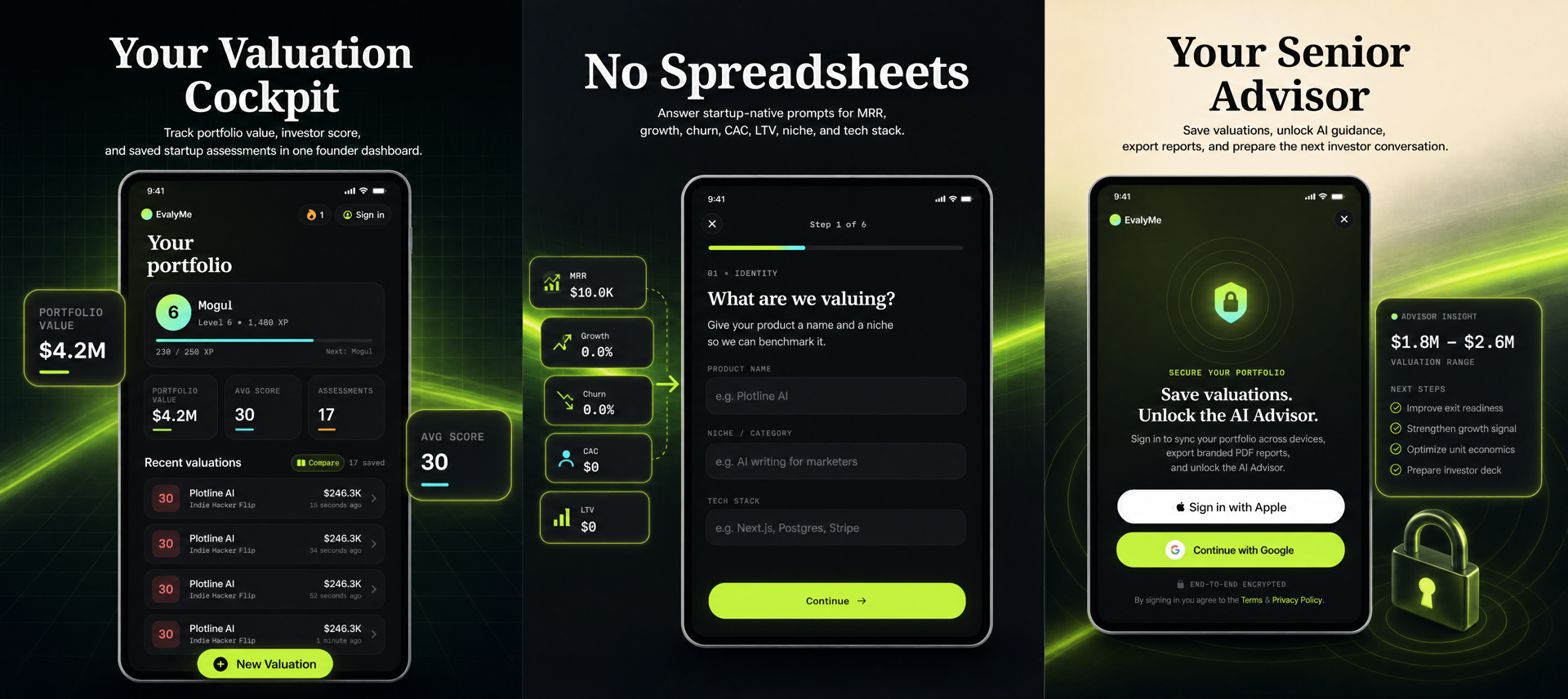
The EvalyMe SaaS valuation calculator is designed to provide a heuristic planning estimate—not a formal appraisal or a guarantee of what a buyer will pay. It uses eight founder-supplied metrics to produce a directional range and a six-factor operating score. This model does not audit your financials, verify customer contracts, or ingest live comparable-company data. Instead, it helps you see how your business might be valued based on its current operating profile and where you can improve.
The calculator’s six-factor score covers revenue strength, unit economics (LTV/CAC), retention (churn), growth velocity, scale potential (active users), and maturity (months active). These weights are published and transparent, so you can see how each input affects the output. The range is calculated using a base multiple for SaaS, adjusted for your growth, churn, LTV/CAC, and age. For details on the methodology, see EvalyMe Valuation Methodology.
It is crucial to remember that the calculator’s output is a scenario tool. It can help you compare different growth or retention strategies, but it does not predict a specific transaction price or account for buyer negotiation, strategic fit, or deal structure. Use it to pressure-test your assumptions, not as a substitute for due diligence.
4. Diagnostic Checklist: What Inputs Matter Most
Before running any valuation estimate, founders should review the following checklist to ensure their inputs are accurate and meaningful:
- Monthly Recurring Revenue (MRR): Use normalized monthly revenue, not annual contracts divided by 12 unless you’ve confirmed the payment schedule and revenue recognition. For annual subscriptions, check if your provider (e.g., Stripe) counts past-due or discounted subscriptions in MRR. See Stripe Analytics for definitions.
- Active Users: Report actual active users, not total signups or email list size.
- Churn Rate: Calculate monthly churn as the percentage of customers who cancel or fail to renew, not just those who downgrade.
- Growth Rate: Use the average monthly growth over the last three to six months.
- Customer Acquisition Cost (CAC): Include all marketing and sales costs, not just paid ads.
- Customer Lifetime Value (LTV): Base this on actual retention and average revenue per user.
- Months in Market: Count from your first paying customer, not just from launch or MVP.
Verifying these inputs before using the calculator will make your estimate more credible and actionable. If you’re unsure about a metric, run several scenarios to see how sensitive your valuation is to each input.
5. Worked Example: Illustrative SaaS Valuation Scenario
Let’s walk through an illustrative example to show how the calculator works. Suppose you operate a bootstrapped SaaS with the following metrics:
- MRR: $8,000 (monthly, not annualized)
- Active users: 300
- Monthly churn: 4%
- Monthly growth: 3%
- CAC: $200
- LTV: $2,400
- Months active: 18
Entering these into the EvalyMe SaaS Valuation Calculator, you’ll receive a heuristic valuation range and a six-factor operating score. For this scenario, the calculator might produce an illustrative range of $420,000–$690,000 USD, with a score breakdown showing strengths in retention and growth but weaknesses in scale potential (due to a small user base).
This example is for illustration only. Your actual range will depend entirely on your own verified metrics and the model’s published weights. The key takeaway: the calculator helps you see which factors are driving your estimate and where to focus improvement efforts.
6. Common Misreads and Limits of Heuristic Models
Heuristic calculators are powerful for scenario planning, but they have critical limits. First, they do not verify your inputs or audit your financial health. If you overstate MRR or understate churn, your estimate will be inflated. Second, the model does not account for strategic fit, buyer-specific synergies, or deal terms that can move a real-world price far outside the estimated range.
Another common misconception is that the six-factor operating score is a valuation multiplier or a direct measurement of defensibility. In reality, it is a weighted summary of your current operating signals, not a guarantee of buyer interest or price. Numeric thresholds for “good” churn or revenue are model assumptions, not universal truths.
Finally, be wary of treating annual contract value as collected cash. Payment timing, discounts, and past-due invoices can all affect what is truly recurring and collectible. For more on these distinctions, see ARR vs MRR: Understanding Their Impact on Startup Valuation.
7. Concrete Founder Actions to Improve Valuation
After running your baseline estimate, use the output to prioritize improvements that will have the most impact:
- Reduce Churn: Review onboarding, support, and product fit to keep more users active month-to-month.
- Boost Growth: Experiment with new acquisition channels or referral programs to accelerate user growth.
- Optimize CAC: Track all acquisition costs and test lower-cost channels or partnerships.
- Increase LTV: Upsell existing customers, launch higher-value plans, or improve retention features.
- Document Processes: Prepare clear handover documentation and automate key workflows to make the business more transferable.
- Verify Metrics: Use your billing provider’s analytics to confirm MRR, churn, and user counts. Adjust your numbers if you find discrepancies.
Each of these actions can be tracked and prioritized using EvalyMe Pro’s task tracking and AI guidance features. Start with the weakest signal in your operating score, and focus on changes that are both achievable and likely to move your valuation range.
8. Using the Calculator as a Planning Tool (and Next Steps)
The EvalyMe calculator is most valuable when used as a scenario and planning tool. Enter your real metrics, review the operating score, and note which factors are helping or hurting your estimate. Use the range as a directional guide—not a negotiation anchor or a price guarantee.
Founders can use the free, no-signup browser calculator for quick estimates, then save their baseline and track improvements in the web workspace or mobile apps. For those preparing for acquisition or investment, Pro features offer tailored playbooks and AI-driven next steps to systematically improve weak signals before going to market.
To get started, visit the Free SaaS Valuation Calculator and review the published methodology for a transparent view of how your estimate is constructed. For more on what a calculator can and cannot tell you, see What a SaaS Valuation Calculator Can—and Cannot—Tell You.