Why Copying Multiples Can Mislead Bootstrapped Founders
Many SaaS founders look for a shortcut to benchmark their startup’s value, often by copying headline acquisition multiples from public companies or VC-backed deals. This approach is risky for bootstrapped teams. Public multiples reflect mature, liquid, and often much larger businesses. They bake in assumptions about scale, defensibility, and growth rates that rarely apply to indie SaaS or early-stage startups. Even within private markets, acquisition multiples can swing wildly due to buyer fit, negotiation, and opaque deal terms. For founders without a sales team or with a product still in early traction, these headline numbers can create a false sense of security or urgency.
Instead, benchmarking should start with your own metrics and a clear understanding of what drives value in your specific context. This means comparing your business to similar-stage, similar-model peers—not just copying a number from a blog post or aggregator. The right approach uses cohort comparison, diagnostic tools, and scenario planning to understand where you stand—and what you can improve.
For more on why two SaaS businesses with the same MRR can sell for very different prices, see Why Two SaaS Businesses With the Same MRR Can Sell for Very Different Prices.
What Actually Moves the Valuation Needle in SaaS
For SaaS businesses, valuation is most sensitive to a handful of operating factors: recurring revenue, growth rate, churn, customer lifetime value (LTV), customer acquisition cost (CAC), and the maturity of the business. These are the levers that heuristic calculators and most buyers will focus on. Recurring revenue provides a baseline, but the sustainability and efficiency of that revenue stream are what drive multiples up or down.
Growth rate signals future potential, but only if it’s sustainable and not the result of a one-off spike. Churn and retention show whether customers stick around, which is critical for SaaS. LTV and CAC measure whether your business can profitably acquire and keep customers. Maturity (how long you’ve been in market) reduces risk for buyers, as does evidence of real, paying users—not just a working AI demo or codebase.
A business with $10,000 MRR, 10% monthly growth, 2% churn, and a 3x LTV/CAC ratio will likely benchmark much higher than one with the same revenue but flat growth and high churn. But these factors interact; a single weak signal can drag down the whole range. For a breakdown of these drivers, see the EvalyMe methodology.
Diagnostic Checklist: Are You Ready to Benchmark?
Before running any valuation benchmark, founders should work through a practical checklist:
- Is your MRR calculation consistent? Normalize annual subscriptions to monthly, and separate cash collected from recurring revenue. Stripe and other providers let you configure whether discounts are included in MRR (Stripe docs).
- Do you know your churn rate and LTV/CAC? If not, estimate conservatively or use calculator defaults, but flag these as areas to improve.
- Are your active user numbers real, not just signups? Buyers and calculators care about usage, not vanity metrics.
- Is your growth rate sustainable over several months? One good launch month doesn’t prove a trend.
- How long have you been in market? Age matters for risk; younger businesses face steeper discounts.
- Have you removed one-off or non-recurring revenue from your baseline?
If you can answer these questions with evidence—not just a guess—you’re ready to run a directional benchmark.
How to Use the EvalyMe Calculator for Cohort Comparison
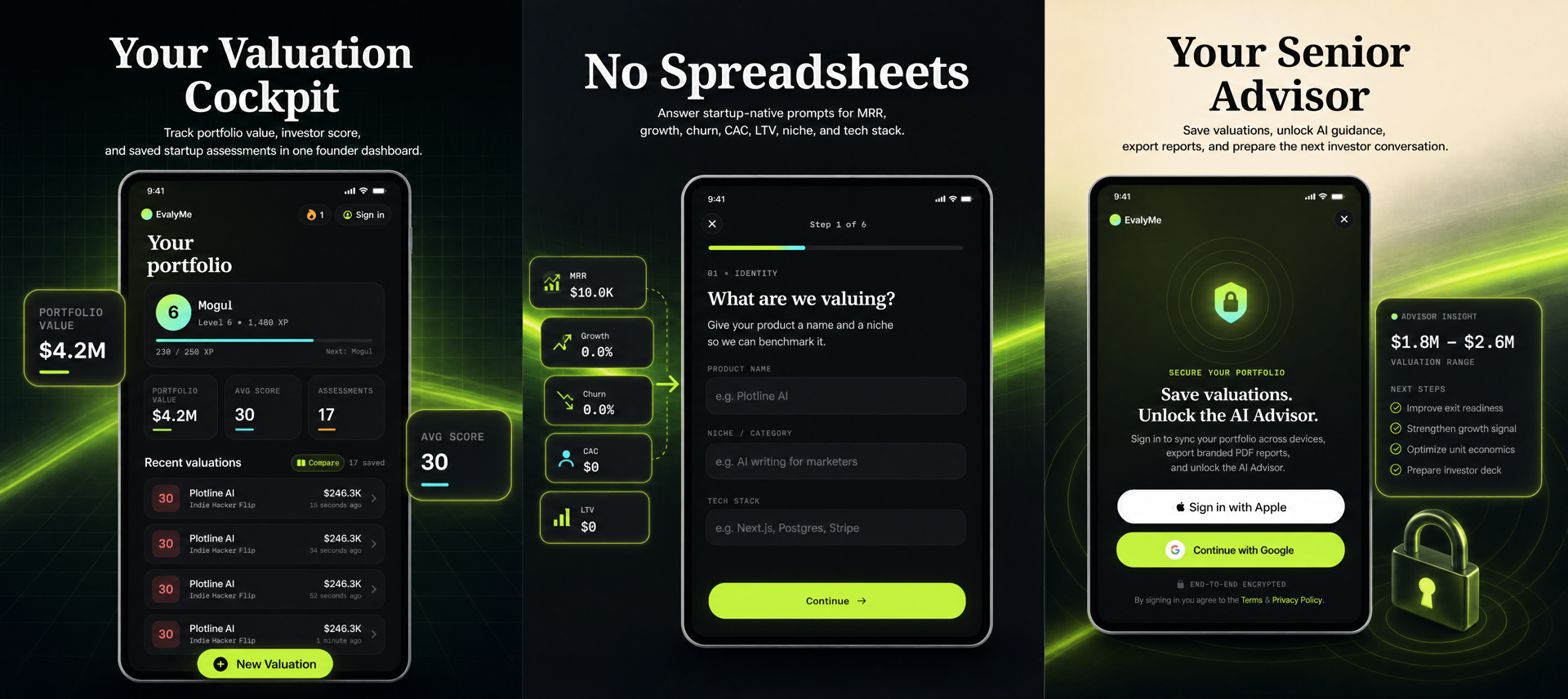
The EvalyMe SaaS Valuation Calculator is designed for founders who want a planning estimate, not a formal appraisal. It takes eight inputs: revenue model, MRR, active users, CAC, LTV, churn, growth, and months in market. The calculator produces a heuristic valuation range and a six-factor operating score, showing what helps or hurts your estimate.
To benchmark, enter your real metrics and review both the range and the score breakdown. The most valuable insight often comes from comparing your score to your own past assessments or to similar businesses you know. For example, if your retention score is much lower than your growth score, that’s a clear signal to focus on churn reduction before expecting a higher valuation.
The calculator does not ingest private deal data or supply industry benchmarks; it’s a scenario tool, not a prediction of what a buyer will pay (methodology). Use it to identify weak signals and set priorities for improvement.
Worked Example: Benchmarking Without Multiples
Suppose you run a SaaS with these metrics:
- MRR: $7,500
- Active users: 400
- CAC: $120
- LTV: $900
- Monthly churn: 3%
- Monthly growth: 6%
- Months in market: 18
Enter these into the EvalyMe calculator. The tool will show a valuation range (say, $500k–$800k, as an illustrative—not market—example) and a six-factor operating score. You’ll see which factors pull the estimate up (e.g., solid growth, decent retention), and which drag it down (perhaps scale potential or business maturity).
Now, imagine a peer SaaS with similar MRR but 8% churn and no growth. Their range and score will be lower, even if both businesses have the same revenue. This direct comparison is more actionable than copying a 5x ARR multiple from a public company. It shows where to focus: for you, maybe scale; for your peer, churn.
Common Limits and False Reads When Benchmarking
Heuristic calculators and cohort benchmarks are not crystal balls. There are several common pitfalls:
- Overstating MRR: Annual deals must be normalized to monthly; payment timing does not prove revenue quality. Stripe lets you configure how discounts are treated in MRR (Stripe docs).
- Ignoring one-off revenue: Only recurring revenue should be benchmarked for SaaS multiples.
- Assuming the calculator’s range is a buyer offer: The EvalyMe estimate is a planning tool, not a guarantee. Real-world deals can move far outside this range due to negotiation, buyer fit, or diligence findings (methodology).
- Confusing the operating score with a valuation multiple: The score is a diagnostic, not a multiplier or a defensibility rating.
- Comparing to irrelevant cohorts: Don’t compare your bootstrapped SaaS to a VC-backed unicorn or a marketplace with a different revenue model.
For more on what a SaaS valuation calculator can and cannot tell you, see What a SaaS Valuation Calculator Can—and Cannot—Tell You.
Concrete Founder Actions for Better Benchmarking
To get the most from benchmarking, founders should:
- Audit your metrics: Verify your MRR, churn, LTV, and CAC calculations. Use Stripe’s analytics exports to drill into customer-level changes (Stripe docs).
- Run a baseline scenario: Use the EvalyMe calculator to generate your current range and score.
- Change one input at a time: See how improving churn or growth shifts your range. This reveals which lever matters most for your business.
- Compare to your own past results: Track whether your operating score and range improve over time.
- Identify your weakest signal: Use the calculator’s breakdown to set your next 30-day priority.
- Avoid overfitting to a single number: Treat the range as directional; focus on improving fundamentals, not chasing a headline multiple.
When to Use (and Not Use) Public or VC-Backed Multiples
Public SaaS multiples can be useful as a directional check, but only after you’ve benchmarked against your own metrics and relevant peers. Use them to sense-check whether your business is in the right ballpark, not as a direct input. VC-backed deals often reflect expectations of hypergrowth, team size, or market dominance that don’t apply to indie SaaS.
If you’re considering an exit, remember that private deals are negotiated individually. Strategic fit, buyer motivation, and diligence findings can swing prices far outside any model range. Use public multiples to challenge your assumptions, not to set your expectations or anchor negotiations.
For a deeper dive into the differences between public and private SaaS multiples, see SaaS Valuation Multiples for Bootstrapped Founders: What Actually Moves the Number.
Next Steps: Using the Calculator for Ongoing Planning
Benchmarking is not a one-time event. Use the EvalyMe SaaS Valuation Calculator as a recurring tool in your operating cadence. Re-run your scenario after major product launches, pricing changes, or shifts in growth. Save your baselines to track progress and use the Pro features for tailored playbooks and task tracking if you’re preparing for an exit.
Always verify your inputs, and remember that the calculator’s range is a planning estimate—not a formal appraisal or a substitute for buyer diligence. For a full explanation of the model’s workings, see the EvalyMe methodology.
Related reading: