All currency amounts in the illustrative examples below are in USD.
1. Why Acquisition Readiness Matters for SaaS Founders
Preparing a startup for acquisition is not just about maximizing a headline number—it’s about reducing friction, increasing buyer confidence, and making your business easy to understand and transfer. For bootstrapped SaaS founders, the gap between a working AI demo and a robust, acquirable business can be substantial. Buyers look for evidence beyond code: recurring revenue, low churn, clean financials, and operational maturity. If these are missing or unclear, even a technically impressive product will face a valuation discount or extended diligence.
Founders should view acquisition readiness as a series of concrete, verifiable steps that make their business more attractive and defensible. This process also clarifies your own decision-making: is the exit you want plausible, and what would you need to improve to reach it? For a breakdown of what actually moves SaaS multiples, see SaaS Valuation Multiples for Bootstrapped Founders: What Actually Moves the Number.
2. Financial Hygiene: Clean Books and Clear Metrics
Buyers expect crisp, verifiable financials. Even if you run lean, you need to produce a basic income statement, cash flow, and a clear record of monthly recurring revenue (MRR). Use a tool like Stripe, or download your billing data to CSV for manual review (Stripe Analytics). Reconcile every customer payment, discount, and refund. If you’ve mixed personal and business expenses, separate them now—ambiguity here is a red flag.
Checklist:
- Export 12–24 months of MRR, churn, and growth data
- Document all expenses, including founder compensation (even if zero)
- Flag any one-off or non-recurring revenue
- Prepare a simple balance sheet (assets, liabilities, cash on hand)
Illustrative example: If your SaaS has $5,000 MRR, $1,000 in monthly expenses, and $2,000 in cash, your books should show these numbers clearly, with supporting bank and Stripe statements. Avoid rounding or estimating—buyers will check.
3. Product and Codebase: From Demo to Durable Asset
A buyer is not just acquiring your code—they want a product that runs reliably, is maintainable, and can be handed over. If your app is an AI-powered demo with hardcoded secrets, missing tests, or manual deployment steps, expect a discount or extended technical diligence. Review your code for security issues (such as leaked API keys—see GitHub Secret Scanning), and document your deployment process.
Checklist:
- Remove hardcoded credentials; use environment variables and rotate any exposed secrets
- Write a README or AGENTS.md that explains setup, dependencies, and deployment
- Ensure at least minimal automated test coverage
- List all third-party services and dependencies, with billing and access details
Concrete action: Run a secret scan on your repositories and rotate any exposed API keys before sharing code with a potential buyer.
4. Customer and Revenue Analytics: Telling a Credible Story
Buyers want to see not just revenue, but the underlying drivers: customer acquisition cost (CAC), lifetime value (LTV), churn, and growth. Use your billing provider’s analytics or export data to calculate these metrics. Be ready to explain any unusual spikes or drops. If you have only a handful of customers, focus on retention and engagement rather than vanity metrics.
Checklist:
- Calculate LTV and CAC for your last 12 months
- Chart monthly churn and growth rates
- Segment customers by plan, cohort, or geography if possible
- Identify your top three sources of new customers
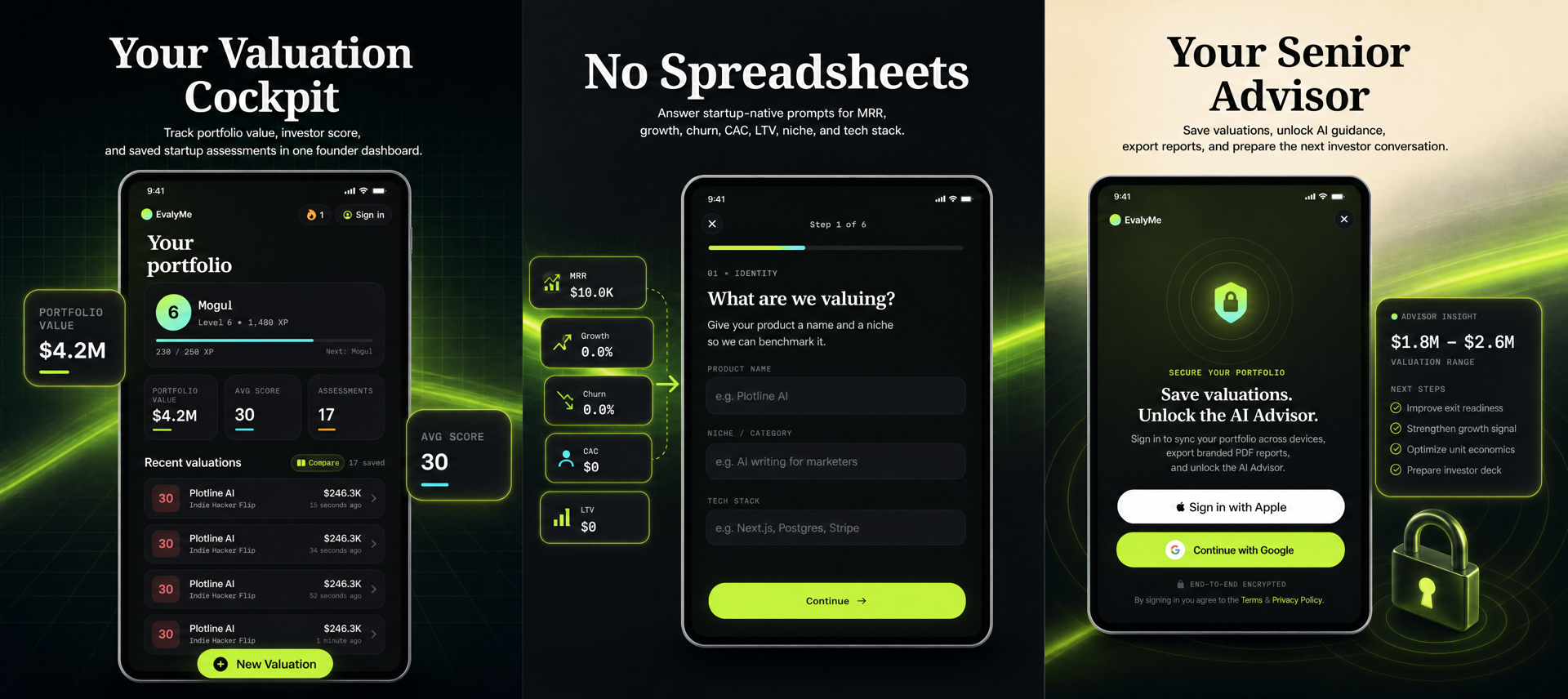
Worked example: If your CAC is $100 and LTV is $600, your LTV/CAC ratio is 6. This is a positive signal, but only if churn is low and growth is steady. Use the EvalyMe SaaS Valuation Calculator to see how these inputs affect your estimated range. Remember, this is a heuristic—not a guarantee of buyer offers (methodology).
5. Legal and Ownership: Avoiding Surprises
Legal issues can derail deals late in the process. Confirm that all intellectual property (IP) is owned by the company, not by contractors or founders personally. Ensure you have signed agreements for any code or assets contributed by third parties. If you use open-source code, verify compliance with licenses. For SaaS, check that your terms of service and privacy policy are up to date and cover your current features.
Checklist:
- All code contributors have signed IP assignment or work-for-hire agreements
- No unresolved legal disputes or outstanding debts
- Up-to-date privacy policy and terms of service
- List of all open-source licenses in use
Action: If you find missing agreements, reach out to contributors now—buyers will require this before closing.
6. Operational Maturity: Beyond the Solo Founder
A SaaS that depends entirely on the founder is harder to sell. Buyers look for evidence that the business can run with minimal handholding. This means documented processes, clear customer support workflows, and at least basic automation for billing, onboarding, and support. Even if you’re a solo founder, write down your key workflows and create a handover plan.
Checklist:
- Document onboarding, support, and billing processes
- List all critical accounts and how to transfer access
- Prepare a 30/60/90-day transition plan
- Identify tasks that can be delegated or automated
Action: Use the EvalyMe Pro playbook to generate a tailored exit-readiness checklist and track your progress. This helps you prioritize what to fix before engaging buyers.
7. Common Pitfalls and False Readiness Signals
Not all signals of readiness are meaningful to buyers. Common false positives include:
- High code quality but no paying customers
- AI demos with no production usage or support history
- Revenue spikes from one-off deals, not recurring subscriptions
- Unverified metrics or missing source data
Limits: The EvalyMe calculator provides a directional estimate based on your inputs—it does not audit your financials, inspect contracts, or price in strategic fit (methodology). Extreme or unverifiable inputs will distort the output but not convince a buyer. For more on what the calculator can and cannot tell you, see What a SaaS Valuation Calculator Can—and Cannot—Tell You.
8. Diagnostic Checklist and Next Steps
Use this diagnostic to assess your readiness:
- Financials: Clean, exportable, and reconciled
- Product: Documented, secure, and maintainable
- Analytics: LTV, CAC, churn, and growth calculated and explained
- Legal: IP, contracts, and compliance in order
- Operations: Documented workflows and handover plan
If you check all five boxes, you are in a strong position to approach buyers or brokers. If not, prioritize the weakest area—buyers will find it first. Run your numbers through the EvalyMe SaaS Valuation Calculator for a scenario estimate, and use the Pro playbook to convert your checklist into a concrete, time-bound plan.
For a detailed exit-readiness timeline, see The 90-Day SaaS Exit-Readiness Plan. Remember: the goal is not just a higher number, but a smoother, more credible exit process that rewards your work and reduces deal risk.