1. What Free Business Valuation Calculators Actually Do
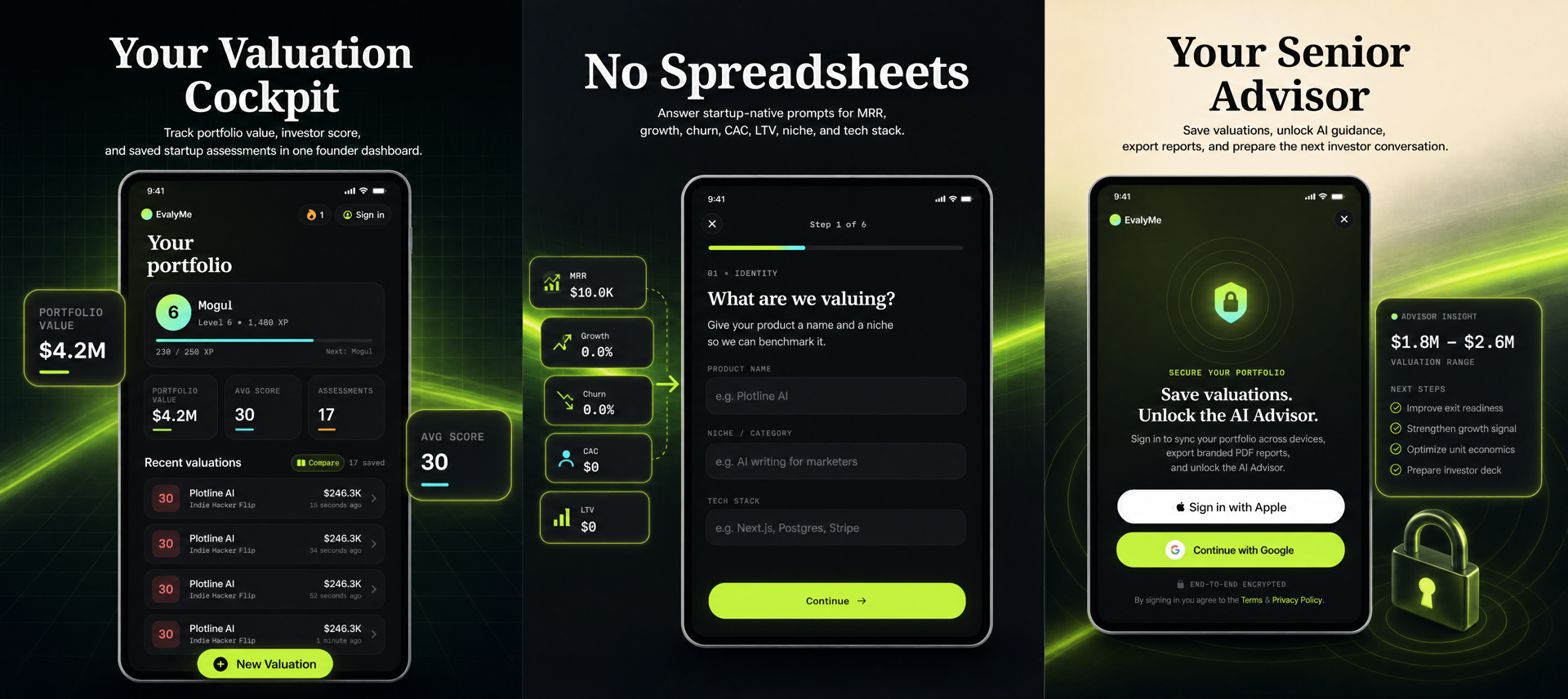
Browser-based business valuation calculators, like EvalyMe’s, provide a fast, consistent way for SaaS and indie founders to estimate a directional valuation range using their own operating metrics. These tools use founder-supplied data—such as monthly recurring revenue (MRR), churn, growth rate, customer lifetime value (LTV), and customer acquisition cost (CAC)—to generate a heuristic estimate. The output is a range, not a single number, and is best used for scenario planning and identifying which business signals are helping or hurting your potential value.
EvalyMe’s calculator, for example, displays a six-factor operating score alongside the valuation range. This score highlights strengths and weaknesses in your business model, but it is not itself a valuation multiplier or an indicator of defensibility. The tool does not audit your financials, verify contracts, or ingest private acquisition data. Its purpose is to help founders pressure-test their assumptions and understand how changes in their metrics could affect their estimated value. For a detailed breakdown of the methodology and formula, see EvalyMe’s methodology.
2. What Paid Professional Assessments Provide
A paid professional business valuation, whether from a broker, accountant, or specialist firm, goes far beyond what a calculator can offer. These assessments typically involve a deep review of your financial records, customer contracts, legal structure, and market positioning. The professional will often request bank statements, tax filings, detailed revenue breakdowns, and sometimes even customer interviews or product demos.
Paid assessments may use standardized valuation methods (like discounted cash flow, precedent transactions, or market comps) and often provide a formal report. This report can be used in negotiations, legal proceedings, or for regulatory compliance. Professionals may also factor in strategic fit, competitive landscape, and buyer-specific considerations that no browser calculator can model. However, these assessments are costly (often thousands of USD) and take weeks to complete. They are most appropriate when you need a defensible number for a real transaction, investor diligence, or a legal requirement.
3. Practical Diagnostic: When Is a Free Calculator Enough?
For most bootstrapped SaaS founders, a free calculator is sufficient for:
- Early-stage planning: Testing how changes in MRR, churn, or growth could affect your future value.
- Internal goal-setting: Comparing your business health to your own past performance or to public reference points.
- Identifying weak signals: Spotting which metrics (e.g., high churn or low LTV/CAC) are dragging down your operating score.
- Scenario analysis: Modeling what happens if you raise prices, improve retention, or accelerate growth.
A free calculator is not enough when:
- You need a formal appraisal for a sale, merger, or legal dispute.
- An acquirer or investor requests audited numbers or a third-party opinion.
- Your business has complex revenue streams, significant debt, or off-balance-sheet items.
For a step-by-step guide to using a calculator for planning, see How to Use a SaaS Business Valuation Calculator: A Practical Guide for Founders.
4. Worked Example: Using EvalyMe’s Calculator for a SaaS Scenario
Suppose you run a SaaS with the following monthly metrics:
- MRR: $10,000
- Active users: 400
- CAC: $200
- LTV: $1,600
- Monthly churn: 4%
- Monthly growth: 3%
- Months in market: 18
Entering these into EvalyMe’s free calculator produces a directional valuation range and a six-factor operating score. Let’s say the calculator returns an illustrative range of $480,000–$780,000 and highlights that your churn is above the model’s neutral threshold, reducing your score. The tool suggests focusing on retention improvement for the next 30 days.
This estimate is not a buyer offer or a certified appraisal, but it helps you prioritize which metric to improve before seeking a real exit. You can rerun the scenario with lower churn or higher growth to see the impact on your estimated value. Try this yourself at EvalyMe’s SaaS Valuation Calculator.
5. Limits and Common False Reads of Free Calculators
Founders should be aware of several common pitfalls:
- Input Quality: Garbage in, garbage out. If your MRR, churn, or LTV are not accurately tracked, the estimate will be misleading.
- No Buyer Context: Calculators do not model strategic fit, buyer-specific synergies, or negotiation dynamics. A real buyer may pay more or less than the range.
- No Diligence: The tool does not verify your data, check for contract risk, or audit your codebase. It cannot detect technical debt, customer concentration, or legal issues.
- Heuristic Multiples: The model uses published revenue multiples and adjustment factors, not live market comps or private deal data. These are directional, not guarantees (see methodology).
- Operating Score Is Not a Multiplier: The six-factor score helps you see what’s strong or weak, but it does not convert directly to a valuation multiple or a defensibility rating.
For more on the limits of calculators, see What a SaaS Valuation Calculator Can—and Cannot—Tell You.
6. Revenue Metrics: Recurring Revenue vs. Cash Collected
A frequent source of confusion is the difference between recurring revenue metrics (like MRR/ARR) and actual cash collected. Most calculators, including EvalyMe’s, ask for MRR as a normalized monthly figure, even if you collect annual subscriptions upfront. This is because payment timing alone does not prove revenue overstatement; annual deals are divided by 12 to reflect monthly performance.
Stripe’s analytics, for example, allow you to configure whether discounts are included in MRR and how active subscribers are counted (see Stripe docs). MRR may include past-due subscriptions or reflect different discount treatments depending on your settings. Always check how your provider defines MRR and ensure your calculator inputs match your actual reporting. Never confuse a spike in cash from annual prepayments with a permanent increase in recurring revenue.
7. Concrete Founder Actions: Getting the Most from Each Approach
To maximize the value of a free calculator:
- Gather accurate, up-to-date metrics: MRR, churn, growth, CAC, LTV, active users, and business age.
- Run multiple scenarios: Adjust one input at a time to see what most affects your range and score.
- Use the operating score breakdown to prioritize improvements (e.g., retention, acquisition efficiency).
- Save your baseline and track progress over time in EvalyMe’s workspace or mobile apps.
If you’re considering a paid assessment:
- Prepare clean financials: Reconcile your Stripe, bank, and accounting records.
- Document contracts, customer lists, and any IP or codebase details.
- Be ready for diligence: Identify risks (churn spikes, customer concentration, technical debt) before a professional flags them.
- Use the free calculator to set expectations and clarify which metrics you want to improve before paying for a formal report.
8. Decision Checklist and Next Steps
Free Calculator Is Sufficient If:
- You’re planning, benchmarking, or prioritizing improvements.
- You want to understand which signals matter most for your business value.
- You do not need a legally defensible or buyer-ready valuation.
Paid Assessment Is Needed If:
- You’re in active sale, merger, or investor diligence.
- A third party requires a formal, documented valuation.
- Your business has complex, non-standard revenue or legal structure.
Next Steps:
- Try EvalyMe’s free browser calculator to get your baseline and see your operating score breakdown.
- Review the methodology to understand how the estimate is built and where it stops being useful.
- For more on preparing for an exit, see The 90-Day SaaS Exit-Readiness Plan.
Remember: A calculator is a planning tool, not a substitute for buyer diligence or a formal appraisal. Use it to guide your next move, not as a guarantee of what your business will sell for.