Investors and acquirers do not read every metric equally. They scan for proof that the business is real, resilient, and still improving.
The exact order changes by category, but the first screen usually answers four questions.
Is Revenue Real?
MRR or ARR gives the first anchor. It tells a buyer whether the product is an experiment, a promising asset, or already a meaningful business.
Revenue quality matters as much as revenue size. Subscription revenue, expansion revenue, and diversified customer revenue all reduce doubt. Manual services, heavy discounts, or one customer carrying the business raise follow-up questions.
Are Customers Staying?
Churn is where many attractive graphs fall apart. Strong growth with high churn can mean the product has demand but weak fit. Lower growth with excellent retention may be more valuable than it looks because each new customer compounds.
Retention turns revenue from a snapshot into an asset.
Is Growth Efficient?
Growth rate tells the upside story. CAC and LTV tell whether that growth can be repeated.
An investor does not need every channel to be perfect. They do need to believe the next dollar spent has a rational path to becoming more than a dollar of durable value.
Can Someone Else Operate It?
For exits, operational clarity matters. Clean analytics, documented systems, low founder dependency, and understandable code all reduce buyer risk.
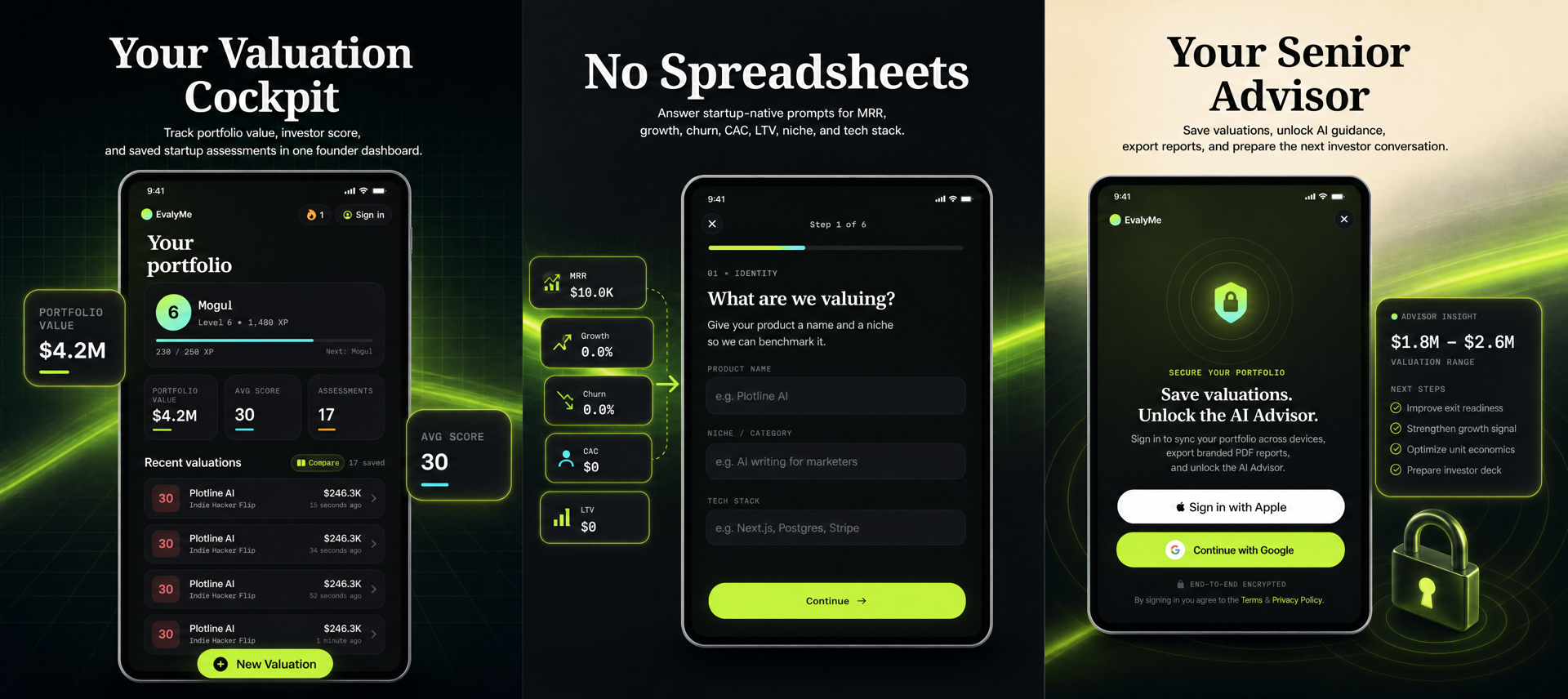
This is why EvalyMe pairs valuation with exit readiness. A strong product can still lose value if the business is hard to verify or hard to transfer.
The Pattern To Watch
One metric rarely carries the whole valuation. The pattern does.
Revenue proves demand. Retention proves fit. Growth proves momentum. Margins and operations prove the business can survive diligence.
When those signals point in the same direction, the valuation conversation gets much easier.